



The supplement industry's favorite fiber has a complicated safety profile
Inulin is in hundreds of products — fiber powders, protein bars, prebiotic capsules, and gut health blends. It's cheap, effective at increasing fiber content, and carries FDA GRAS (Generally Recognized As Safe) status. That combination makes it nearly irresistible to manufacturers.
But GRAS status, as we'll cover in detail below, does not mean what most consumers assume. And clinical tolerance data raises legitimate questions about who should be taking isolated inulin at all.
This is not a case of a dangerous ingredient that needs to be banned. It's a case of an ingredient whose risk profile is far more specific and nuanced than the marketing communicates — and where the mismatch between marketing claims and clinical data has real consequences for millions of people.
---
Prebiotics vs. probiotics: a distinction the industry routinely blurs
Inulin and fructooligosaccharides (FOS) are prebiotics. A prebiotic is a substrate — essentially a food source — that selectively feeds bacteria already living in your gut. It does not introduce new live organisms. That's what a probiotic does.
This distinction matters more than most people realize.
If your gut microbiome is healthy and well-balanced — diverse populations of beneficial bacteria, low levels of pathogenic species — then feeding those bacteria with inulin can support short-chain fatty acid production, including butyrate, which nourishes colon cells and modulates inflammation.
If your gut flora is dysbiotic — a condition where harmful or opportunistic bacteria have outcompeted beneficial strains — then selectively feeding your gut bacteria with inulin may amplify the wrong populations. You're not correcting the imbalance. You're potentially accelerating it.
This caveat is absent from virtually all prebiotic supplement marketing, which either conflates prebiotics with probiotics or presents "feeding your gut bacteria" as universally beneficial regardless of what those bacteria actually are.
---
What animal research found — and what it doesn't prove
In 2018, research published in Cell found that in mice with dysbiotic microbiomes, the fermentation of isolated inulin by pathogenic bacterial pathways was associated with liver cancer development in approximately 60% of subjects.
This finding requires context before interpretation.
Mouse gut physiology differs substantially from human gut physiology. Cancer development timelines in rodent models don't map directly to human carcinogenesis. No prospective human trial has replicated this finding.
What the data does establish is a plausible biological mechanism: dysbiotic fermentation of isolated inulin can produce metabolites that, in the right (or wrong) conditions, may be harmful rather than beneficial. That mechanism — if active in humans — would disproportionately affect the populations most likely to be reaching for gut health supplements: people who already have compromised gut flora.
The practical implication is not "inulin causes liver cancer." It is: if you have a known gut condition, inflammatory bowel disease, or liver issue, consult a gastroenterologist before taking isolated inulin supplements.
---
Clinical tolerance: no dose was symptom-free
Clinical tolerance studies examining inulin-type fructans across doses of 5g, 10g, and 20g per day produced a consistent finding: every dose level caused increased gastrointestinal symptoms, including flatulence, borborygmus (audible gut rumbling), and abdominal distension.
No dose studied was symptom-free.
The mechanism is straightforward. Gut bacteria produce enzymes that ferment inulin. Those bacterial populations need time to upregulate enzyme production in response to increased inulin availability. When you start at a high dose — as most supplement labels instruct — you overwhelm that enzymatic adaptation, producing rapid fermentation and gas accumulation before the bacterial ecosystem has adjusted.
Most supplement labels recommend serving sizes of 15–20g. That is precisely the range at which symptoms are most pronounced. The instruction to "start with one full serving" is directly at odds with what the tolerance data supports.
If you are a healthy adult who chooses to use an inulin-based supplement: start at no more than 3–5g daily and increase slowly over 2–4 weeks. This mirrors the gut's actual adaptation timeline.
---
What FDA GRAS status actually covers
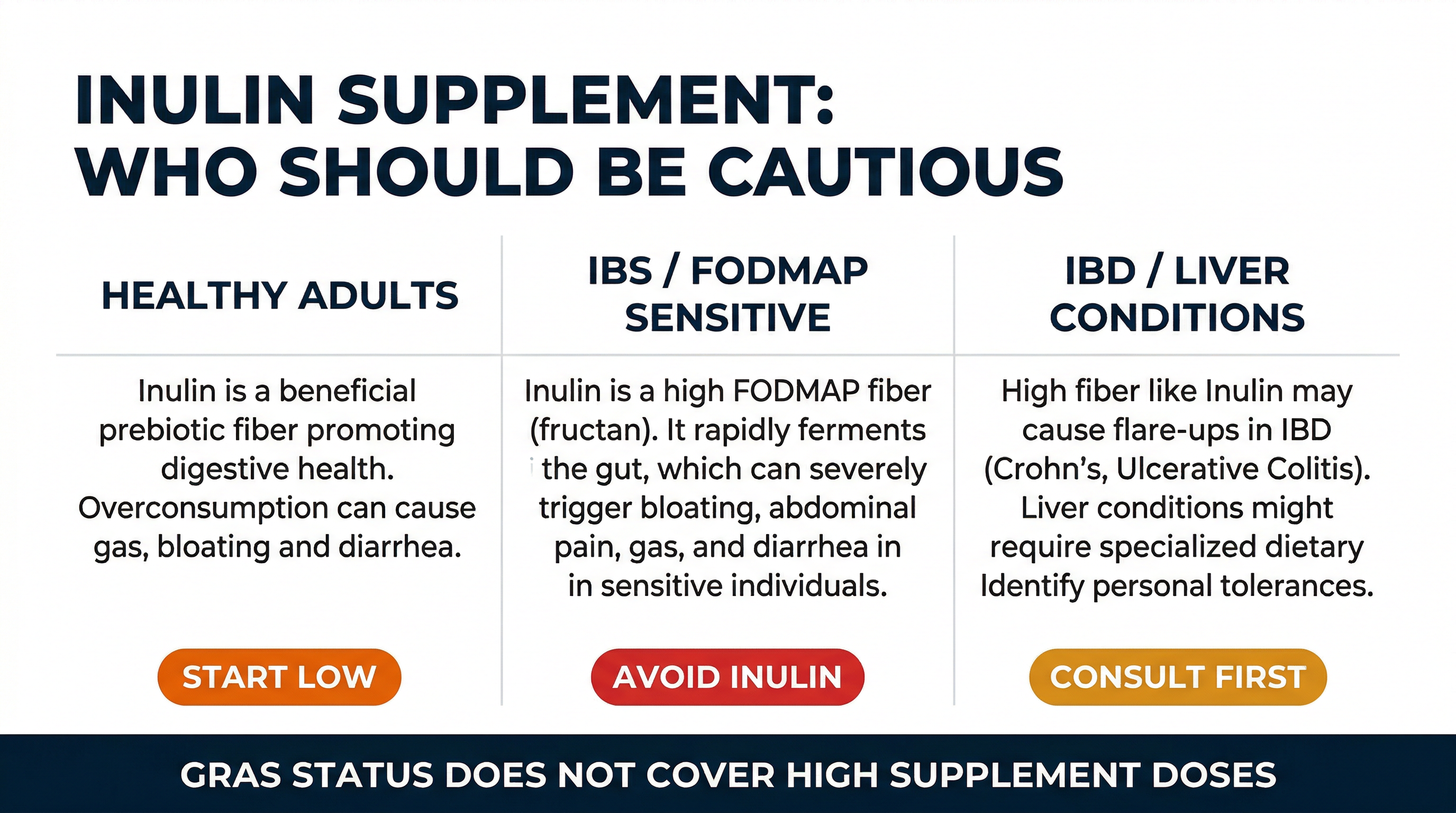
FDA's Generally Recognized As Safe designation for inulin and FOS applies to their use as food ingredients at typical food-level exposures — the amounts naturally found in foods like chicory root, garlic, onions, and artichokes, or added to products to achieve similar exposure levels.
- High supplement doses (typically 10–20g per serving)
- Use in individuals with dysbiotic gut flora
- Use in individuals with inflammatory bowel disease or liver conditions
- Long-term therapeutic supplementation
This distinction is important because supplement manufacturers frequently invoke GRAS status as a proxy for general safety — implying FDA endorsement of therapeutic-level use. That implication is not supported by the regulatory framework. The FDA's own GRAS notices for inulin and FOS confirm the classification scope.
---
High-risk populations: IBS and FODMAP sensitivity
For individuals with irritable bowel syndrome (IBS) or who follow a low-FODMAP diet for symptom management, inulin and FOS present a specific and significant problem.
Both compounds are classified as high-FODMAP — meaning they are fermentable oligosaccharides that rapidly draw water into the intestine and are quickly fermented by colonic bacteria. In FODMAP-sensitive individuals, this process produces pronounced bloating, cramping, and diarrhea at doses that would be considered moderate or safe in healthy adults.
- Psyllium husk — a soluble fiber that forms a gel, slows transit, and feeds bacteria without the FODMAP burden
- Partially hydrolyzed guar gum (PHGG) — a partially broken-down fiber that is well tolerated in IBS populations and supports beneficial bacterial growth without triggering osmotic symptoms
It's worth noting that FODMAP sensitivity is not necessarily permanent. Some individuals can reintroduce high-FODMAP foods after a gut-healing period, under the guidance of a registered dietitian.
---
Why whole food fiber outperforms the isolated powder
Whole food fiber — the fiber found in lentils, black beans, oats, broccoli, and onions — is physically embedded in a food matrix alongside polyphenols. These plant compounds co-regulate how gut bacteria ferment the fiber, influencing which metabolites are produced and in what ratios.
Isolated inulin powder lacks these cofactors entirely.
Preliminary research suggests this structural difference may affect the profile of short-chain fatty acids (SCFAs) produced during fermentation. Straight-chain SCFAs — particularly butyrate — are the primary fuel source for colon epithelial cells and have well-documented anti-inflammatory effects. Branched-chain SCFAs, associated with protein fermentation rather than fiber fermentation, do not have the same beneficial profile.
Whole food fiber sources tend to promote straighter-chain SCFA production. Isolated fiber supplements may produce different ratios. Head-to-head RCT comparisons in humans are limited, but the mechanistic basis is biologically coherent.
A cup of cooked lentils contains approximately 15g of fiber, a meaningful dose of polyphenols, and all the regulatory cofactors intact. The isolated powder contains none of the latter.
---
Practical guidance
If you have IBS, FODMAP sensitivity, IBD, or liver disease: Avoid isolated inulin and FOS supplements. Discuss low-FODMAP fiber alternatives (psyllium husk, PHGG) with a gastroenterologist or registered dietitian.
If you are a healthy adult considering inulin supplementation: Start at 3–5g daily. Increase by 2–3g per week over 2–4 weeks. Never start at full label dose. Monitor for GI symptoms and back down if needed.
If you currently take a fiber supplement: Check the ingredient label for inulin, chicory root extract, inulin-type fructans, FOS, or fructooligosaccharides. If present, verify the dose matches clinically studied amounts (typically 5–15g/day in healthy adults) and confirm the dose is appropriate for your health status.
If your fiber comes from whole foods: You're already accessing fiber with its regulatory cofactors intact. Prioritizing legumes, oats, and vegetables over isolated fiber supplements is supported by the current evidence base.
---
Sources
- Dynamic response of gut microbiota to FOS and inulin — PubMed
- GRAS Notice 687 — Inulin from Agave tequilana — FDA
- GRAS Notice 605 — Fructo-oligosaccharides — FDA
- GRAS Notice 717 — Short-chain FOS — FDA
- FDA Science Review — Isolated Non-Digestible Carbohydrates
- Clinical Trial NCT04716868 — Inulin Tolerance Protocol
- Clinical Trial NCT05318183 — Whole Food vs Isolated Fiber
- Clinical Trial NCT04211766 — Gut Microbiota and Fiber
- Low-FODMAP Diet Research — Examine
---
Disclaimer: This content is for educational purposes only and does not constitute medical advice. We do not diagnose or treat any condition. Always consult a qualified healthcare provider for personalized recommendations about supplements, dosage, and potential interactions.
Sources
- Dynamic response of different types of gut microbiota to fructooligosaccharides and inulin - PubMed
- GRAS Notification - Inulin from Agave tequilana - FDA
- GRAS Notice 717, Short-chain fructo-oligosaccharides - FDA
- GRAS Notice 605 - Fructo-oligosaccharides - FDA
- Science review of isolated and synthetic non-digestible carbohydrates - FDA
- Clinical Trial Protocol NCT04716868 - ClinicalTrials.gov
- Assessing Gut Microbiota Mediated Health Outcomes of Whole Foods - ClinicalTrials.gov
- Clinical Trial Protocol NCT04211766 - ClinicalTrials.gov
- Low-FODMAP Diet - Examine
- Research Breakdown on Low-FODMAP Diet - Examine
- MELFIB STUDY Clinical Trial Protocol - ClinicalTrials.gov