



Obese people who swore they were eating only 1,200 calories were actually eating 2,100 — and their metabolisms were completely normal.
This is not a motivational story. It is a measurement finding from the 1992 Lichtman study, published in the British Journal of Nutrition. The researchers used doubly labeled water, the gold standard for objective energy expenditure measurement. Ten obese subjects reported roughly half of what they actually consumed. Their resting metabolic rates sat within five percent of predicted values. No slow metabolism. No broken hormones. Just a massive gap between perception and reality.
The Gold Standard That Exposed the Gap
Doubly labeled water measures total energy expenditure by tracking isotope elimination. It requires no food logs. No memory. No honesty. The subject drinks water containing stable isotopes of hydrogen and oxygen, then provides urine samples over one to two weeks. The isotope disappearance rates reveal carbon dioxide production, which maps directly to calorie burn.
Self-reported intake requires none of this infrastructure. It requires memory, perception, and willingness to disclose. The Lichtman study found these inputs systematically fail in obese populations. The 47% figure comes from ten subjects — small sample, but the effect size was so large it demanded attention. Subsequent studies confirmed underreporting ranges from 20% to 50% depending on BMI and assessment method.
Social Desirability Reshapes Memory
The distortion is not primarily conscious lying. Research from the National Cancer Institute's dietary assessment primer documents social desirability bias: participants overreport "healthy" foods and underreport "unhealthy" foods due to concern about researcher judgment. This bias operates without awareness. The presence of an interviewer intensifies it, but it persists even in self-administered digital tools.
The mechanism is reconstructive memory. When recalling meals, people reconstruct from schemas — general knowledge about what they typically eat, what they should eat, what sounds acceptable. The actual plate recedes. The idealized plate replaces it. Vegetables grow. Snacks shrink. Oil disappears.
BMI Predicts Misreporting Magnitude
Underreporting prevalence and magnitude climb with body weight. Normal-weight individuals misreport too, but overweight and obese individuals show higher frequency and larger absolute gaps. The reasons are multifactorial: larger portions are harder to estimate visually, higher intake variability creates more memory opportunities, and social pressure intensifies with perceived stigma.
This has direct implications for nutrition research. Any study using self-reported intake in higher-BMI populations without validation or BMI-stratified analysis risks systematic error. Clinicians should prefer objective measures — doubly labeled water when feasible, indirect calorimetry for resting rate, or at minimum structured protocols that reduce bias — in these patients.
The Hidden Variable: Weight Change Status
Energy intake equals energy expenditure only during weight stability. This seems obvious but is routinely ignored. If someone is actively losing weight, their measured energy expenditure exceeds their actual intake. This energy deficit can be misread as accurate reporting: the numbers "match" because the deficit is built into the expenditure side, not the intake side.
Conversely, someone gaining weight shows expenditure below intake. The measured numbers diverge in predictable directions based on weight trajectory, not reporting accuracy. Always verify two to four weeks of weight stability before assessing any dietary log's validity. This single step would eliminate a substantial portion of published research errors.
Practical Protocol: What to Do Instead
The research supports specific, actionable corrections:
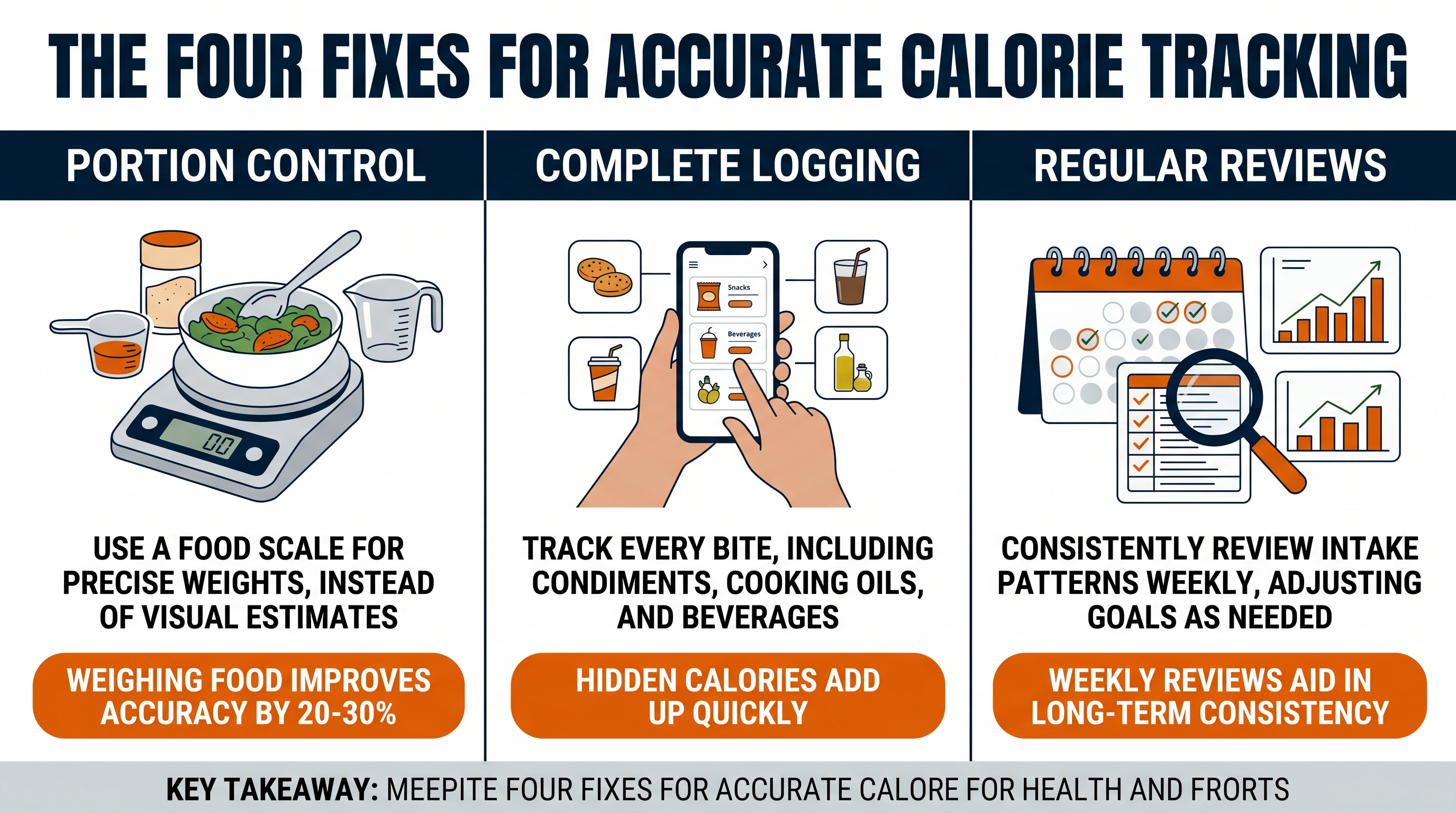
Photograph every meal before eating. Images provide objective records that bypass reconstructive memory. Review them before logging.
Use structured recall aids. Generic "what did you eat yesterday" prompts fail. Specific timing cues, portion references, and food category checklists improve accuracy.
Track in non-judgmental environments. Remove social pressure. Avoid sharing logs publicly. Use anonymous tools where possible.
Assume logging error before metabolic adaptation. The base rate of true metabolic adaptation is low. The base rate of logging error is high. Prioritize accordingly.
Verify weight stability. Two to four weeks of stable weight before validating any intake estimate.
The Hope Principle Applied
This is not a debunking exercise. It is empowerment. The metabolism you feared was broken is probably functioning normally. The plateau you attributed to hormones is probably attributable to math. The fix is mechanical, not pharmaceutical. Better measurement yields better results.
Your metabolism is probably fine. Your math is probably wrong. The research has been clear since 1992.
--- Disclaimer: This content is for educational purposes only and does not constitute medical advice. We do not diagnose or treat any condition. Always consult a qualified healthcare provider for personalized recommendations about supplements, dosage, and potential interactions.
Sources
- Lichtman et al. (1992). The validity of self-reported energy intake as determined using the doubly labelled water technique. British Journal of Nutrition. https://www.cambridge.org/core/journals/british-journal-of-nutrition/article/validity-of-selfreported-energy-intake-as-determined-using-the-doubly-labelled-water-technique/E2F8CD392DFB6F955BB38A98D6A94ADD
- Energy expenditure by doubly labeled water: validation in lean and obese subjects. PubMed. https://pubmed.ncbi.nlm.nih.gov/1909495
- Social Desirability in Dietary Assessment. National Cancer Institute. https://epi.grants.cancer.gov/dietary-assessment-primer/learn/social.html
- Misreporting of energy intake in the elderly using doubly labeled water. PMC. https://pmc.ncbi.nlm.nih.gov/articles/PMC3404807
- Reported Energy Intake Accuracy Compared to Doubly Labeled Water. PMC. https://pmc.ncbi.nlm.nih.gov/articles/PMC5372975
Sources
- The validity of self-reported energy intake as determined using the doubly labelled water technique | British Journal of Nutrition
- Energy expenditure by doubly labeled water: validation in lean and obese subjects - PubMed
- Misreporting of energy intake in the elderly using doubly labeled water
- Learn More about Social Desirability | EGRP/DCCPS/NCI/NIH
- Traditional Self-Reported Dietary Instruments Are Prone to...
- Reported Energy Intake Accuracy Compared to Doubly...
- Validity and accuracy of artificial intelligence-based dietary intake assessment methods: a systematic review