

Longevity Science Breakthroughs: What the Evidence Actually Says About Living Longer
The longevity conversation tends to drift toward expensive interventions, exotic supplements, and genetic destiny. The science, read carefully, points elsewhere.
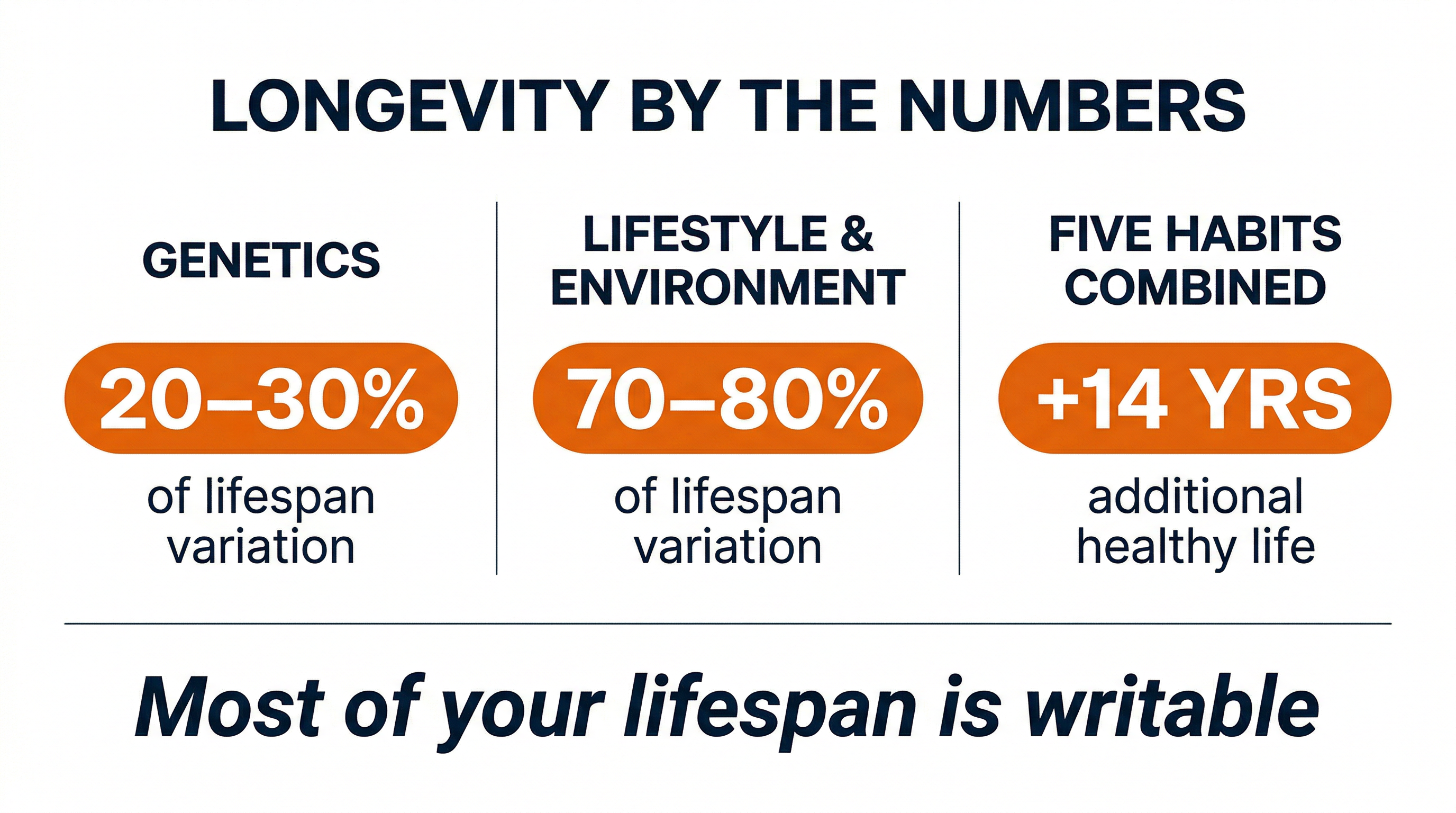
Lifestyle factors — particularly physical activity, diet, body weight, alcohol intake, and smoking status — collectively account for 70–80% of lifespan variation in large population studies. Your genes matter. They're just not running the show.
---
Genetics Are a Minority Stakeholder in Your Lifespan
Twin studies consistently place the genetic heritability of lifespan at 20–30%. This figure may slightly underestimate gene-environment interactions, but the practical implication is clear: your daily behaviors carry far more statistical weight than your DNA.
Polygenic risk scores — genetic profiles that estimate your inherited disease risk — reinforce the same message. Individuals with high polygenic risk for early mortality can still meaningfully offset that risk through consistent healthy lifestyle modification. Your genes write the opening conditions. Your habits write most of the story.
---
The Biggest Longevity Lever Most People Haven't Pulled
If you're currently sedentary, no supplement, biohack, or optimization protocol delivers the return of a single behavioral shift: starting to move.
WHO meta-analysis data shows the transition from fully sedentary to any regular physical activity is associated with approximately a 20–25% reduction in all-cause mortality risk — dying from any cause, at any age, from any disease.
This figure comes primarily from observational cohort data, where healthy-user bias can inflate benefit estimates. But the finding is robust across multiple large datasets and methodology types. The direction of effect is not in doubt.
The practical implication: if you currently do nothing, the highest-return move isn't optimizing an existing routine. It's starting one.
---
You Don't Need a Gym. You Need to Move Vigorously.
Accelerometer-based research has changed how exercise physiology thinks about incidental activity — movement that happens in the context of daily life rather than scheduled workouts.
Short bouts of vigorous incidental physical activity — brisk walking to a destination, climbing stairs, carrying groceries at pace — show mortality outcomes comparable to structured exercise sessions in accelerometer data.
This is observational evidence, and reverse causation is a legitimate concern (healthier people naturally move more). But the finding is consistent: you don't need a gym membership to access the longevity benefits of physical activity. Deliberate vigorous movement woven into daily tasks appears to deliver comparable returns.
The gym isn't irrelevant. It just isn't the mandatory gate.
---
Age Is Not an Exemption from the Benefits
Physical activity produces significant all-cause mortality reduction across every adult age group studied — including adults over 60 — with no identified upper age threshold beyond which the benefit disappears.
The LIFE Study, a randomized controlled trial, demonstrated measurable health improvements in sedentary older adults who began low-intensity exercise programs. WHO evidence tables for adults over 64 confirm the pattern across broader populations.
The caveat: RCT follow-up periods in older adults are typically short — one to three years — limiting confidence in long-term mortality data specifically. But the direction of effect is consistent. Starting at 65 still counts. Starting at 72 still counts.
---
Five Habits, Fourteen Extra Years
Harvard cohort research tracked five modifiable lifestyle factors in large US adult populations:
- Healthy diet — diet quality score in the top 40th percentile
- Regular physical activity — at least 30 minutes of moderate-to-vigorous activity daily
- Healthy body weight — BMI 18.5–24.9
- Moderate or no alcohol consumption — 5–15g/day for women, 5–30g/day for men
- Non-smoking — never smoked or quit
Adults who sustained all five factors had up to 14 additional healthy life-years compared to those with none.
Two things stand out in this finding. First, the effect is additive — each factor contributes independently, and the combination exceeds any single factor's contribution by a wide margin. Second, the threshold for each factor is achievable, not elite. This isn't about perfecting one behavior. It's about five good-enough behaviors sustained over time.
Residual confounding from socioeconomic status — which correlates with both lifestyle and longevity — remains a legitimate caveat. But the magnitude and consistency of this finding across multiple cohorts gives it substantial weight.
---
What Epigenetic Clocks Are Actually Measuring
Biological age research has accelerated significantly over the past decade. DNA methylation epigenetic clocks — tools that read chemical tags on your DNA that accumulate with aging — now predict disease risk and all-cause mortality more accurately than chronological age alone.
These clocks measure something real: the rate at which your cells are accumulating aging-related changes, independent of the year you were born. Research consistently links physical activity to slower biological aging on these clocks.
A critical caveat: epigenetic clocks are research tools. Commercial direct-to-consumer versions vary widely in validation quality, and clinical interpretation remains contested among researchers. The science underlying the clocks is solid. Many specific products built on that science are not.
If you encounter a consumer biological age test, treat the output as a rough signal, not a clinical measurement — until standardization and independent validation catch up.
---
What This Means Practically
The longevity science converges on a surprisingly un-dramatic conclusion: consistent moderate inputs, sustained over time, compound into meaningful outcomes.
Start here:
- Take the stairs. One staircase replaced today becomes a default behavior tomorrow.
- Park further away and walk briskly. The vigor matters — accelerometer studies specifically track vigorous incidental movement.
- Add a 10-minute brisk walk after one meal. Post-meal movement also has metabolic benefits beyond mortality.
- Audit the five-factor stack. You don't need to perfect all five simultaneously. Identify which is your weakest and add one improvement this week.
- Ignore your birth year as destiny. Your biological age is influenced by your behavior. The clocks confirm this.
The biology responds to small consistent inputs. It always has.
---
- WHO Guidelines on Physical Activity and Sedentary Behaviour
- WHO Draft Evidence Profile – Incidental Physical Activity
- WHO Evidence on Physical Activity for Older Adults
- LIFE Study – Lifestyle Interventions and Independence for Elders (RCT)
- Lifespan Heritability – Twin Study Data
- Impact of Healthy Lifestyle Factors on Life Expectancy in the US
- Healthy Lifestyle Factors and Mortality
- Epigenetic Clocks: Beyond Biological Age
- DNA Methylation as a Marker of Biological Age
- The Association Between Epigenetic Clocks and Physical Activity
--- Disclaimer: This content is for educational purposes only and does not constitute medical advice. We do not diagnose or treat any condition. Always consult a qualified healthcare provider for personalized recommendations about supplements, dosage, and potential interactions.
Sources
- Heritability of delay discounting in adolescence: a longitudinal twin study
- WHO Guidelines on Physical Activity and Sedentary Behaviour
- WHO Draft Evidence Profile – Physical Activity
- WHO Evidence on Physical Activity for Older Adults (over 64 years)
- The LIFE Study – Lifestyle Interventions and Independence for Elders
- Epigenetic Clocks: Beyond Biological Age, Using the Past to Predict the Future
- Epigenetic Clock: DNA Methylation as a Marker of Biological Age
- The Association Between Epigenetic Clocks and Physical Activity
- Impact of Healthy Lifestyle Factors on Life Expectancies in the US Population
- Influence of Lifestyle on Incident Cardiovascular Disease and Mortality
- IARC 50th Anniversary Abstract Book – Genetic and Environmental Risk Integration