



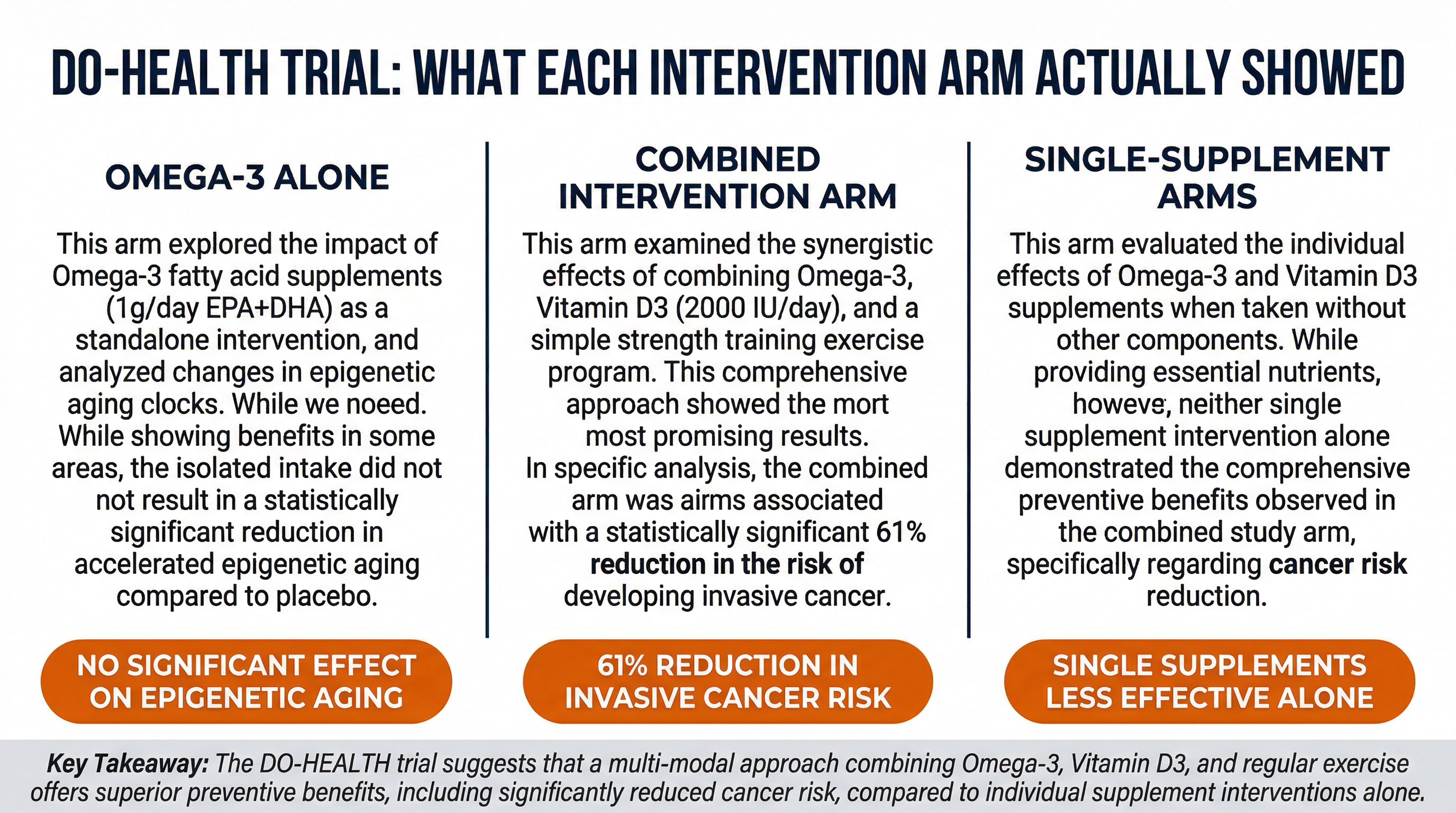
The headline was never about fish oil alone
The statistic has circulated widely: a 61% reduction in invasive cancer incidence, attributed to omega-3 supplementation, from a major clinical trial. The attribution is wrong.
The DO-HEALTH trial — a large, multi-centre randomised controlled trial across five European countries — tested omega-3, vitamin D3, and home resistance exercise both individually and in combination. The 61% cancer reduction was observed exclusively in the combined intervention arm. Participants taking omega-3 alone, vitamin D3 alone, or exercising alone did not replicate that result.
It's also worth being precise about what kind of evidence this is. Cancer incidence was not the trial's primary endpoint. The finding comes from a post-hoc analysis — a secondary look at the data after the main results were collected. That makes it hypothesis-generating: an important signal worth investigating further, not a confirmed anti-cancer effect. Any source presenting it as a proven omega-3 cancer benefit is misreading the data.
What the epigenetic aging data actually shows
The more robust — though still preliminary — finding from DO-HEALTH concerns epigenetic aging. A post-hoc analysis of the trial found that omega-3 supplementation at 1,000–2,000mg of combined EPA+DHA per day was associated with measurably slowed epigenetic aging, as measured by methylation clocks including GrimAge and PhenoAge.
Methylation clocks work by measuring patterns of chemical modifications to DNA — specifically, methyl groups added to cytosine bases at specific sites across the genome. These patterns shift predictably with biological age. GrimAge and PhenoAge are considered more accurate proxies of biological aging than telomere length, which was the earlier standard in longevity research.
The confidence in this finding sits at approximately 0.68 — moderate. It emerged from secondary analyses rather than a pre-registered primary endpoint. The practical takeaway is that the omega-3 effect on epigenetic aging appears real but modest, and it is substantially strengthened by pairing with vitamin D3 and regular resistance exercise. The combination arm consistently outperformed any single intervention.
The dosing error affecting most consumers
This is the most actionable issue in the entire omega-3 conversation, and it's almost never discussed directly.
A standard fish oil capsule labelled as 1,000mg typically contains approximately 300mg of combined EPA+DHA — the two omega-3 fatty acids that the research measures. The remaining 700mg is other fats, carrier oil, and encapsulation material. These are not inert, but they are not the active compounds driving the outcomes in clinical trials.
Label regulations do not require EPA+DHA content to be displayed prominently on the front of the package. The capsule weight — 1,000mg, 1,200mg, 1,500mg — is what gets the large-print treatment. The actual EPA and DHA values are buried in the Supplement Facts panel, listed separately, in smaller type.
To reach 1,000–2,000mg of combined EPA+DHA daily — the range used in the DO-HEALTH epigenetic aging analysis — most consumers would need 3–7 standard capsules per day. The majority take one. This is not a rare dosing error; it is the default.
- Ignore the capsule weight on the front of the bottle entirely.
- Find the Supplement Facts panel on the back or side.
- Locate the EPA row. Note the milligrams.
- Locate the DHA row. Note the milligrams.
- Add them together. That number is your real omega-3 dose per serving.
Higher-concentration formulations — often labelled as "high-potency" or "concentrated omega-3" — can deliver 600–800mg or more of EPA+DHA per capsule, making it practical to hit the therapeutic range with 2–3 capsules. Look specifically for these numbers on the Supplement Facts panel, not the marketing copy.
Oxidation: the quality problem nobody warns consumers about
Fish oil is a polyunsaturated fat. That chemical structure makes it susceptible to oxidation — a degradation process triggered by light, heat, and oxygen exposure.
The TOTOX score (Total Oxidation value) is the standard measurement of fish oil quality. It combines two sub-measurements: the peroxide value (primary oxidation products) and the anisidine value (secondary oxidation products). An acceptable TOTOX is 26 or below; an acceptable peroxide value is 5 meq/kg or below. Studies testing commercially available fish oil supplements have found a meaningful proportion of products exceeding both thresholds — sometimes substantially.
The consequence is not merely reduced potency. Oxidised fish oil generates reactive aldehydes — compounds that increase oxidative stress in human tissue. For a supplement taken specifically to support longevity and reduce biological aging, consuming oxidised fish oil creates a direct conflict with the intended effect.
Packaging plays a significant role. Clear plastic or glass bottles allow light to accelerate photo-oxidation throughout the product's shelf life. Dark amber glass or fully opaque containers represent a basic quality standard for potency retention. However, packaging alone cannot guarantee quality — a product can be properly packaged but still arrive oxidised if manufacturing or shipping conditions were poor. Third-party oxidation certification, with a documented TOTOX score below 26, is the more reliable quality signal.
- Refrigerate the product.
- Keep it in its original opaque container, tightly sealed.
- Do not expose to direct sunlight or heat sources.
- If the oil smells rancid, distinctly fishy, or chemically sharp, discard it — these are sensory indicators of advanced oxidation.
A note on bleeding risk and upper dose limits
FDA medical review data indicates that clinically meaningful bleeding risk is low at or below 3g of combined EPA+DHA per day in the general healthy population. Above that threshold, dose-related increases in bleeding time are documented.
Since no evidence supports additional anti-aging benefit beyond 2g/day, there is no rationale for exceeding that amount. Individuals taking anticoagulants, antiplatelet medications, or NSAIDs on a regular basis should disclose omega-3 supplementation to their prescribing clinician — this is the specific interaction that warrants clinical oversight, not incidental use at standard doses in healthy adults.
The practical protocol
The research points clearly toward a combination approach. Omega-3 supplementation at 1,000–2,000mg EPA+DHA daily, combined with vitamin D3 and regular resistance exercise, represents the most evidence-aligned strategy for supporting biological age metrics based on current data.
That combination is also, not coincidentally, accessible and low-risk for most healthy adults. No prescription required. No exotic compounds. The barrier is not availability — it is knowing what the research actually studied, reading labels correctly, and selecting a product that hasn't already degraded before it reached you.
- Read EPA + DHA on the Supplement Facts panel — ignore capsule weight
- Target 1,000–2,000mg combined EPA+DHA daily
- Look for third-party oxidation certification with TOTOX under 26
- Choose opaque packaging; clear bottles are a quality risk
- Refrigerate after opening; discard if it smells rancid
- Pair with vitamin D3 and resistance exercise for the strongest evidence-based outcome
- Stay under 3g/day; disclose to your clinician if you take anticoagulants or NSAIDs
- DO-HEALTH post-hoc analysis — epigenetic aging, omega-3, vitamin D3, exercise: https://pubmed.ncbi.nlm.nih.gov/39900648/
- Examine.com — Vitamin D and epigenetic aging: https://examine.com/research-feed/study/dNXyO0
- EPA+DHA content analysis in commercial fish oil: https://pubmed.ncbi.nlm.nih.gov/33955300/
- Examine.com — Fish oil dosing overview: https://examine.com/supplements/fish-oil/
- FDA Medical Review — Omega-3 NDA 204977: https://www.accessdata.fda.gov/drugsatfda_docs/nda/2014/204977Orig1s000MedR.pdf
- FDA Medical Review — Omega-3 NDA 205060: https://www.accessdata.fda.gov/drugsatfda_docs/nda/2014/205060Orig1s000MedR.pdf
- Fish oil oxidation, TOTOX scores, and compliance: https://pubmed.ncbi.nlm.nih.gov/33382790/
- Examine.com — Fish oil research breakdown: https://examine.com/supplements/fish-oil/research/
--- Disclaimer: This content is for educational purposes only and does not constitute medical advice. We do not diagnose or treat any condition. Always consult a qualified healthcare provider for personalized recommendations about supplements, dosage, and potential interactions.
Sources
- Individual and additive effects of vitamin D, omega-3 and exercise on epigenetic aging (DO-HEALTH post-hoc analysis)
- Supplementation with vitamin D may be associated with slower epigenetic aging — Study Summary
- Analysis of Omega-3 Fatty Acid Content in Fish Oil Products
- Fish Oil benefits, dosage, and side effects — Examine.com
- FDA Medical Review — Omega-3 NDA 204977 (bleeding risk and dosing)
- FDA Medical Review — Omega-3 NDA 205060 (bleeding time at 3g/day)
- Fish oil supplements, oxidative status, and compliance behaviour
- Selective disruption of NRF2-KEAP1 interaction — mechanistic study
- Research Breakdown on Fish Oil — Examine.com